Abyssal Lapidary activation anomaly: Demo Guide
Understand Abyssal Lapidary's anomaly warnings, unusual finds, and activation lore, with practical demo tips and clearly labeled player experience.
What the Activation Anomaly Search Actually Refers To
A rock that seems to react to your tools can turn a relaxing workday into something much less comfortable. The Abyssal Lapidary activation anomaly matters because the demo mixes valuable discoveries, unsettling encounters, and unexplained warnings with ordinary gemstone processing. If you are searching for the Abyssal Lapidary activation anomaly, the first distinction to understand is that an active anomaly warning and activating a monolith are not established as the same mechanic.
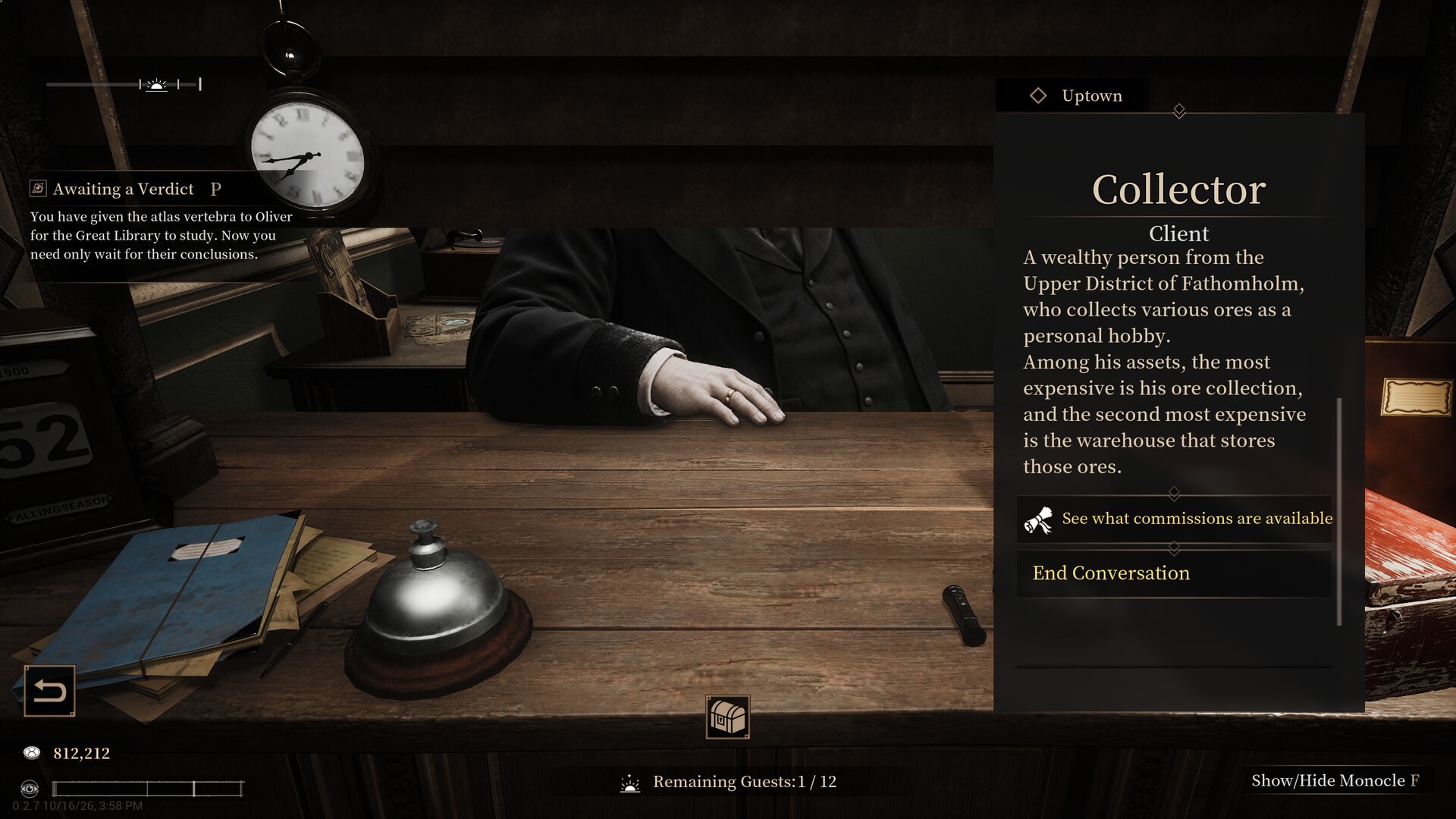
Official screenshot · Source: Steam store
The available demo material does not document a system officially named “activation anomaly.” Instead, player experience in EllieZare’s October 23 demo VOD includes references to an active anomaly being present, unusual material inside rocks, and lore about activating ancient structures with specially cut gems.
This guide separates those observations from confirmed crafting progression and explains how to investigate without wasting your best specimens.
Scope: This article covers the reference material available on October 24, 2026. The gameplay transcript is repetitive and imperfect, so exact interface wording, hidden triggers, and numerical effects should not be treated as verified documentation.
| Topic | What the references support | What remains unconfirmed |
|---|---|---|
| Active anomaly warning | Player experience includes references to an anomaly being present | Exact trigger, duration, and removal conditions |
| Unusual rock contents | Player experience describes relics and living tissue | Complete discovery pool and drop rates |
| Awareness | The player associates changing visuals with awareness | Thresholds and precise effects |
| Monolith activation | Read-aloud lore specifies a point-cut diamond | A completed activation sequence in the demo |
| Faceting progression | Published coverage identifies the Silver License as the unlock | Any direct relationship to anomaly control |
The useful takeaway is simple: do not assume a strange warning requires a special gemstone, and do not assume every unusual discovery is a bug.
Abyssal Lapidary Activation Anomaly: What Is Known?
Abyssal Lapidary’s normal business involves buying raw material, extracting minerals, processing gems, and serving customers. Its horror elements interrupt that routine rather than replacing it.
PC Gamer’s hands-on coverage of the Abyssal Lapidary demo confirms the basic workshop structure: rock processing, tool repair, customer trading, and later access to gem faceting. It also mentions a visitor interested in mysterious artifacts.
That article does not explain anomaly activation. Most anomaly-specific information here comes from player experience, not a developer walkthrough.
An active warning is not a documented activation recipe
In the VOD transcript, the player reads or reacts to wording about an active anomaly being present. That supports treating anomalies as something encountered during gameplay, but it does not establish what caused the warning.
There is no reliable basis in the supplied sources for claiming that you must:
- Break a specific number of rocks.
- Reach a particular awareness value.
- Extract living tissue to activate every anomaly.
- Hold a relic for a fixed amount of time.
- Insert a gemstone to clear the warning.
Those could be hypotheses to test, but they are not verified instructions for the Abyssal Lapidary activation anomaly.
Unusual discoveries deserve careful handling
Player experience includes descriptions of glowing material, objects that appear reactive, and discoveries identified as living tissue. The player also attempts to extract relics and encounters feedback indicating that an object remains too deeply embedded.
These observations suggest a practical priority: keep extraction and interpretation separate. First determine whether the object can be removed using ordinary workshop interactions. Then investigate its identity and any associated effects.
A frightening appearance does not, by itself, tell you which tool to use or whether you should destroy the find.
How to Investigate an Anomaly Without Wasting Materials
There is no verified universal “disable anomaly” procedure in the references. However, a controlled investigation is more useful than repeatedly striking the same spot while a warning is active.
Use the following workflow as practical troubleshooting advice, not as an official anomaly solution.
| Step | Suggested action | Why it helps |
|---|---|---|
| 1 | Pause tool use and read the current feedback | Separates anomaly wording from extraction or durability messages |
| 2 | Inspect the sample from several angles | Reveals remaining rock connections and exposed contents |
| 3 | Use the inspection light where available | Helps locate visible color or overlooked inclusions |
| 4 | Remove surrounding rock incrementally | Reduces unnecessary contact with the discovery |
| 5 | Retry extraction after a meaningful change | Tests whether embedding is still the obstacle |
| 6 | Record the warning and what happened immediately before it | Creates a reproducible observation rather than a guess |
Check what is still attached
One recurring extraction problem in the player experience is a specimen that looks free but remains connected by a small piece of surrounding material.
Before applying another heavy strike, inspect the underside and narrow contact points. A tiny connection may be easier to miss than a large covering layer.
For example, if extraction reports that a relic remains embedded, first look for remaining material around its edges. Do not immediately conclude that the active anomaly has locked the extraction interaction.
Keep tools ready before delicate work
Tool durability repeatedly becomes a problem in the VOD. Published coverage also confirms that the workshop includes a repair station.
A sensible preparation routine is to:
- Check durability before opening a promising sample.
- Keep some money available for repairs.
- Clear enough storage space for discoveries.
- Avoid starting delicate work immediately before the day ends.
These steps do not prevent supernatural encounters. They prevent ordinary workshop problems from complicating them.
Track one variable at a time
When investigating the Abyssal Lapidary activation anomaly, note the sample, the action you performed, and the warning that followed. If you simultaneously switch tools, remove material, advance time, and change rooms, you cannot tell which action mattered.
A short record such as “warning appeared after exposing the central object; extraction still reported embedding” is more useful than “this rock is cursed.”
Repeat an observation before treating it as a rule.
Monolith Activation Is a Separate Lore Thread
The clearest activation instruction in the transcript concerns an ancient structure, not an anomaly warning.
During exploration, the player reads lore describing a recess that accepts a diamond with a point cut. Additional text connects specially cut gems with monoliths drawing power from something called the Intrusion.
That is relevant to the Abyssal Lapidary activation anomaly search, but it should not be turned into a guaranteed anomaly cure.
| Feature | Anomaly-related observations | Monolith activation lore |
|---|---|---|
| Main context | Strange encounters and workshop discoveries | Ancient structures within Vermilion House |
| Relevant object | Relics or unusual material appear in player experience | A point-cut diamond is explicitly specified |
| Available instruction | No complete procedure established | Place the specified gem into a recess |
| Demonstrated outcome | Player reactions, warnings, and unusual finds | No completed activation outcome established |
| Demo limitation | Horror encounters appear in player experience | Related structures are described as unavailable in the demo |
Why the cut matters
The lore presents specially shaped gemstones as functional components, not merely decorative keys. That makes the requested mineral and cut important details to preserve.
If an interaction specifies a point-cut diamond, a different gem or a different faceting pattern should not be assumed equivalent. However, the available material does not establish minimum weight, required grade, whether the gem is consumed, or what activation ultimately changes.
The transcript also describes a descending, backbone-like rock formation and lost techniques associated with controlling it. That connects gem cutting to the house’s larger mystery, but the player’s interpretation is not a tested full-game solution.
Do not spend everything chasing an unavailable interaction
Published coverage confirms that the Silver License unlocks the gem faceting table. It does not say that earning this license enables every ancient structure or resolves anomaly warnings.
For a demo playthrough, unlock faceting because it expands your crafting options. Do not grind money under the assumption that a point-cut diamond will necessarily remove an active anomaly.
Awareness, Strange Events, and Problems That Look Similar
Player experience associates visual changes with awareness and describes unsettling sounds and encounters. The same playthrough also includes a freeze that required restarting.
These are different categories of evidence. A disturbing scene may be intentional horror; an unresponsive interface may be a technical problem. Neither should automatically be blamed on the Abyssal Lapidary activation anomaly.
| What you encounter | Most useful first interpretation | Recommended next step |
|---|---|---|
| An anomaly-related warning | An unexplained gameplay state | Record the exact wording and preceding action |
| An object remains embedded | Extraction is not yet permitted | Inspect remaining surrounding material |
| Exhausted tool durability | A normal equipment limitation | Use the repair station |
| Insufficient storage | An inventory-capacity problem | Organize or sell appropriate items |
| Insufficient net weight | A customer requirement is unmet | Check the item’s remaining weight |
| Controls stop responding | A possible technical issue | Test normal exit controls before restarting |
What awareness does—and does not—tell us
The player comments that colors change with awareness and describes increasingly unsettling experiences. That is useful player experience, but it does not establish a complete awareness system.
The sources do not provide verified thresholds, a maximum value, or a dependable relationship between awareness and individual anomaly events. They also do not demonstrate a universal reset method.
The player associates petting the cat with recovering sanity, but the transcript does not verify an exact meter change. Treat that as an observation worth checking in your own game, not a guaranteed treatment.
Avoid damaging your business while investigating
Anomaly research still happens inside a shop-management game. Customer requirements can include material type, grade, cut, color, and net weight, as reflected in the playthrough.
Before sacrificing a promising specimen to experimentation, check whether it could complete a commission. Likewise, avoid faceting everything immediately: a customer’s requested form matters more than making every item look polished.
PC Gamer also notes that inaccurate grinding reduces gem value. Practice ordinary crafting on less valuable material before combining it with unfamiliar supernatural discoveries.
Restart only when you are actually stuck
In the player experience, restarting after a freeze returned the player to an earlier point in the day. That makes a restart a potentially costly troubleshooting step.
First check whether a menu is open, a tool remains equipped, or an interaction can be exited normally. If controls truly remain unresponsive, restarting may be necessary—but it is not an established anomaly-clearing mechanic.
The best approach to the Abyssal Lapidary activation anomaly is patient observation: read the feedback, protect valuable finds, and distinguish repeatable mechanics from dramatic timing.
FAQ
What is the Abyssal Lapidary activation anomaly?
The supplied references do not establish “activation anomaly” as an official mechanic name. The search appears to combine anomaly warnings encountered during play with separate lore about activating monoliths using specially cut gemstones.
How do you remove an active anomaly in the demo?
The available material does not verify a universal removal method. Record the warning, inspect the current specimen, and address ordinary extraction, durability, or inventory problems separately. No specific gem, action count, or waiting period is confirmed as a cure.
Can you activate the monolith with a point-cut diamond?
Read-aloud lore specifies a point-cut diamond for a recess, but the playthrough also indicates that related structures are unavailable in the demo. The sources do not demonstrate a successful activation or establish its outcome.
Are living tissue and relics safe to extract?
Player experience includes attempts to extract both, but it does not establish a complete safety system or predictable consequences. Inspect carefully, remove surrounding material gradually, and avoid assuming that an unusual object follows ordinary gemstone rules.
Related Guides
Abyssal Lapidary AI Usage: What Players Should Know
Explore Abyssal Lapidary AI usage claims about textures, English localization, and coding, plus what remains unverified and how to check.
Abyssal Lapidary awareness: Effects and Recovery
Learn how Abyssal Lapidary awareness rises, what hallucinations and mental overload mean, and how to manage abnormal minerals and recovery.
Abyssal Lapidary corrupt materials: What We Know
Learn what Abyssal Lapidary reveals about corrupt materials, unusual rawstones, extraction risks, and the mechanics still awaiting confirmation.
Abyssal Lapidary walkthrough: Demo Crafting Guide
Start the Abyssal Lapidary demo with practical ore-cutting tips, a community-reported hacksaw workaround, and guidance for crafting and exploration.
Abyssal Lapidary Steam Next Fest: Demo Release Guide
Explore the Abyssal Lapidary Steam Next Fest demo, including its 4+ hours of content, save transfers, new features, and PC requirements.