Abyssal Lapidary gem cutting: Beginner Guide
Explore Abyssal Lapidary gem cutting, from ore appraisal to jewelry crafting, with confirmed mechanics and practical tips for the demo.
What to Know Before Your First Cut
A valuable gemstone—or something disturbingly alive—could be hiding inside your next piece of ore. Understanding Abyssal Lapidary gem cutting matters because mineral appraisal, impurity removal, and precise shaping connect your workshop work to jewelry crafting. This beginner’s guide to Abyssal Lapidary gem cutting explains the confirmed crafting process and offers a practical approach to learning the demo without presenting unverified strategies as facts.
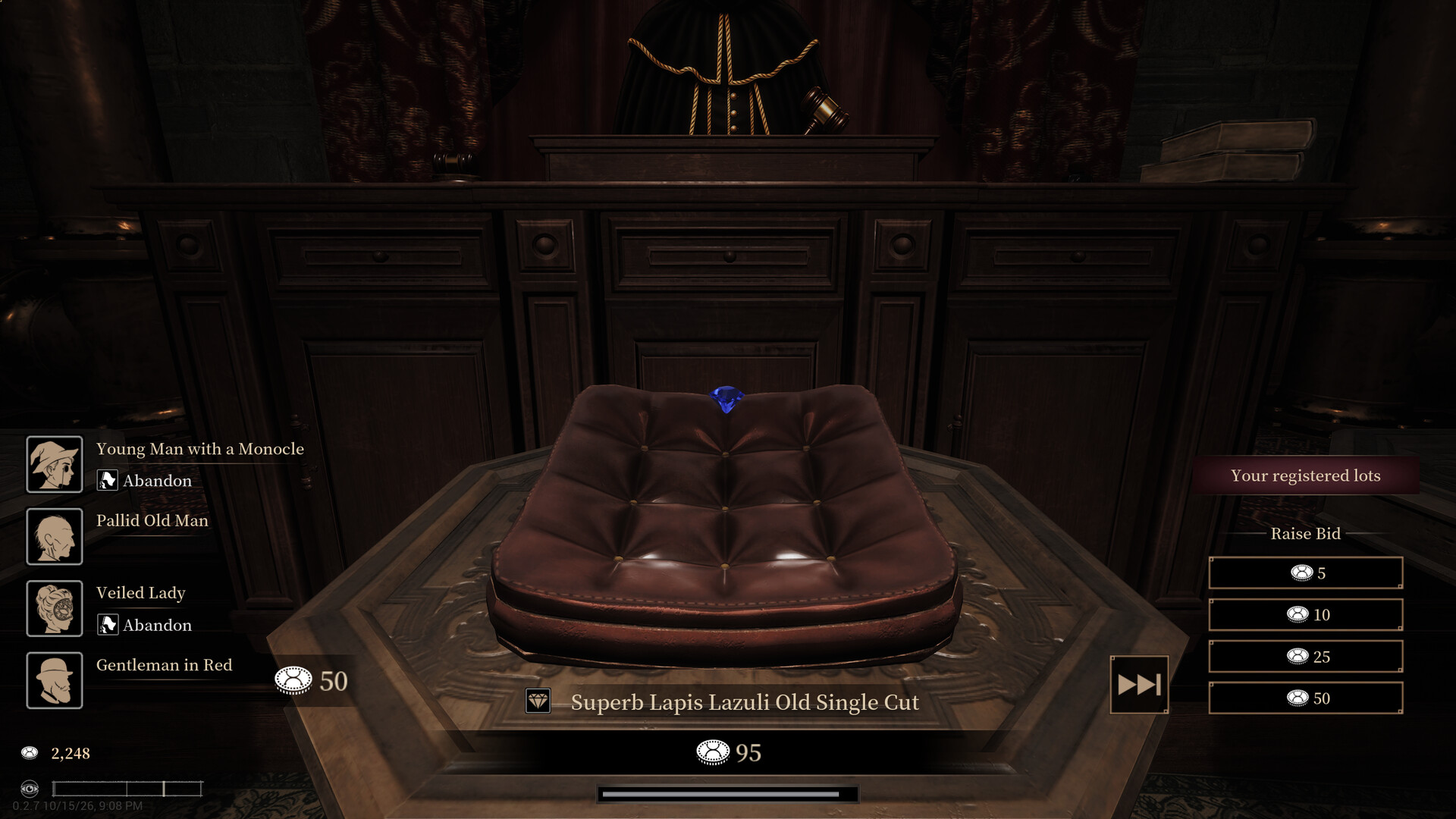
Official screenshot · Source: Steam store
You inherit Vermilion House, a struggling establishment in the underground city of Fathomholm. Your work involves transforming rough minerals into gems and jewelry for an increasingly unusual clientele, while investigating the building’s unsettling history.
As of October 24, 2026, the full game is listed as “Coming soon,” and a free Steam demo is available. This guide draws on the official store description, not hands-on testing. Exact controls, cutting angles, pricing formulas, and mineral-specific solutions are not established by that description.
| Topic | Confirmed information | What remains unspecified |
|---|---|---|
| Ore appraisal | You examine and appraise raw minerals | Appraisal controls and valuation formulas |
| Gem cutting | Impurity removal and precise facets are part of crafting | Ideal angles, tool settings, and scoring rules |
| Mineral behavior | Different minerals behave differently | A complete list of mineral properties |
| Jewelry | Polished gems can be set into jewelry | Recipes, setting requirements, and bonuses |
| Progression | Higher reputation brings stranger clients | Reputation thresholds and reward calculations |
For downloads, announcements, and the current release status, visit the official Abyssal Lapidary Steam page.
How Abyssal Lapidary Gem Cutting Works
The official description establishes a broad workflow: examine rough minerals, remove impurities, cut facets, and turn the resulting gems into jewelry. Think of these as connected stages rather than assuming the cutting step alone determines the outcome.
The sequence below is a useful learning framework, not a verified walkthrough of every demo prompt.
| Stage | Confirmed activity | Recommended beginner focus |
|---|---|---|
| Appraisal | Examine rough ore | Read available information before using tools |
| Preparation | Remove impurities | Learn how the game distinguishes unwanted material |
| Faceting | Shape precise surfaces | Observe how each action changes the stone |
| Jewelry crafting | Set polished gems into jewelry | Check any displayed requirements before committing |
Start with appraisal, not assumptions
Appraisal is explicitly part of the game. That makes inspection a sensible starting point, even though the store page does not explain which measurements or indicators the interface provides.
Before cutting, read whatever descriptions, prompts, or tutorial instructions are available. Separate what the game actually tells you from what you infer from a stone’s appearance.
For example, an unusual vein might look important, but appearance alone does not establish whether it is valuable material, an impurity, or a narrative detail. Let the game’s instructions guide that distinction.
Treat impurity removal as its own lesson
The developers identify removing impurities as a crafting activity. However, there is no documented rule in the supplied material for how much material to remove or which tool to use.
A practical learning habit is to inspect the result after each meaningful action. If the interface displays feedback, compare it with the stone’s previous condition. This helps you understand the relationship between an action and its result without assuming that more cutting always means a better gem.
Learn faceting through feedback
Facets are the shaped surfaces of a gemstone. Abyssal Lapidary emphasizes precise facet work, but its public description does not supply a universal cutting pattern.
Avoid importing real-world gemstone angles or strategies from another crafting game as if they were confirmed solutions here. Instead, follow the demo’s instructions and observe its responses.
For Abyssal Lapidary gem cutting, the most useful early objective is understanding what the game recognizes as successful work—not chasing an undocumented “perfect cut.”
A Practical Plan for Your First Demo Session
Your first session should answer a few basic questions: How does inspection work? What does a cutting action change? How does the finished gem connect to jewelry?
This approach gives you a manageable learning goal without requiring an optimized build or a complete mineral database.
1. Check your version and available guidance
The supplied Steam listing includes an October 23, 2026 announcement titled “Demo 0.2.15 Patch Notes.” That confirms a patch announcement exists, but its contents are not included in the reference material.
Check the current announcements and in-game guidance before relying on an older walkthrough. Record your demo version if you plan to compare results with other players.
2. Establish a baseline
If the demo lets you choose what to work on, begin with a task you understand rather than one whose instructions are unclear.
Write down the starting information the interface provides. That could include a mineral name, a description, or a requested outcome—if those details are displayed. Do not assume every stone exposes the same information.
3. Change one thing at a time
When you have room to experiment, isolate one decision. For instance, compare the feedback before and after a single cutting action rather than performing several unfamiliar actions in quick succession.
This is a recommended testing method, not a confirmed hidden mechanic. Its value is simple: fewer simultaneous changes make results easier to interpret.
4. Record the outcome
A short workshop log can turn a confusing session into a useful reference.
| Record | What to write down | Why it helps |
|---|---|---|
| Starting material | The displayed name or your own description | Keeps different stones from being confused |
| Task | Any instructions shown by the game | Preserves the intended goal |
| Action | The tool or operation you used | Connects decisions with outcomes |
| Feedback | Messages or visible changes | Grounds conclusions in observation |
| Version | Your current demo build | Helps identify potentially outdated advice |
5. Review before repeating
After finishing a task, identify one thing you learned and one thing still uncertain. That is more useful than labeling the entire attempt a success or failure.
Abyssal Lapidary gem cutting should become easier to reason about as you build observations, but one successful attempt does not prove that the same method works for every mineral.
Better Cutting Decisions—and Common Mistakes
The clearest official guidance is that minerals behave differently. Your learning process should reflect that variation rather than assume every rough stone needs identical treatment.
Use evidence instead of a universal recipe
When you encounter a different mineral, revisit its instructions and feedback. A familiar appearance does not establish identical behavior, and the store description does not document real-world mineral rules such as hardness or cleavage.
For a useful comparison, keep your questions consistent:
- What information is available before cutting?
- What changes after impurity removal?
- What feedback follows facet work?
- Does the finished result satisfy the displayed task?
- Which conclusions are observations, and which are guesses?
These questions support better decisions without inventing systems the game has not confirmed.
| Common mistake | Why it is unreliable | Better approach |
|---|---|---|
| Using one method for every mineral | Mineral behavior varies | Reassess each unfamiliar material |
| Assuming more cuts improve quality | No such rule is documented | Check the result of each meaningful action |
| Applying real-world cutting angles automatically | The game’s angle rules are unspecified | Follow in-game guidance |
| Treating a striking visual effect as a bonus | Its mechanical meaning may be unclear | Look for explicit feedback |
| Chasing a “best money” strategy immediately | Prices and profit formulas are undocumented here | Learn the workflow before optimizing |
Keep cutting and jewelry goals connected
Gem production is not the end of the advertised crafting process. You also set polished stones into jewelry for Fathomholm’s residents.
When a task provides requirements, review them before shaping the stone. This is a general planning recommendation, not confirmation that the demo uses particular sizes, shapes, or quality thresholds.
The important distinction is between making a gemstone and making something suitable for the task in front of you. Abyssal Lapidary gem cutting belongs within that larger workshop process.
Use saves thoughtfully
Steam lists a Save Anytime accessibility feature. Saving before an unfamiliar task is therefore worth considering, but the listing does not explain save slots, rollback behavior, or recovery from individual crafting actions.
Do not assume a save guarantees you can reverse every mistake. Check how saving works in your build before using it as the basis for experiments.
Jewelry, Reputation, and the Horror Beneath the Workshop
Abyssal Lapidary combines craftsmanship with a gothic mystery. Its setting matters because the stones are not presented merely as ordinary workshop supplies.
The official description includes unsettling mineral phenomena, growing perception, hallucinations, and secrets within Vermilion House. It does not establish a numerical sanity system, a corruption meter, or a specific penalty attached to cutting strange ore.
Watch closely without inventing explanations
When a stone behaves unusually, distinguish the event from its possible meaning. You might observe something disturbing without yet knowing whether it affects crafting, advances the story, or serves both purposes.
That distinction keeps your notes useful and avoids turning atmosphere into an unsupported rule.
Understand what reputation actually confirms
The store page links increasing reputation with increasingly strange customers. It does not explain exactly how reputation is earned or how customer rewards are calculated.
For now, treat reputation as a confirmed part of progression—not proof of a particular profit strategy.
Likewise, there is no source-backed ranking here for the most profitable mineral, fastest jewelry order, or best facet pattern. A trustworthy Abyssal Lapidary gem cutting guide should leave those questions open until they can be supported.
Make the workshop comfortable to use
The Steam listing identifies color alternatives, camera comfort, custom volume controls, and play without quick-time events among its accessibility features.
Review available settings early, especially if visual clarity or camera movement affects your ability to inspect stones. The exact options should be checked in your current build.
Your most reliable starting strategy is straightforward: inspect first, follow the game’s instructions, observe each action, and keep conclusions specific to what you have actually seen.
FAQ: Abyssal Lapidary Gem Cutting
How does Abyssal Lapidary gem cutting work?
The confirmed process includes examining rough minerals, removing impurities, and carving facets to produce gemstones. Polished gems can then be incorporated into jewelry. Exact controls, ideal angles, and scoring formulas are not explained in the supplied official description.
Is there a best cutting pattern for every stone?
No universal pattern is established by the available source. The developers specifically describe minerals as behaving differently. Follow the current tutorial and compare feedback rather than assuming one successful method applies to every material.
Can I play Abyssal Lapidary now?
As of October 24, 2026, the Steam listing offers a free demo, while the full game remains listed as “Coming soon.” Check the current store page for changes to demo availability or release plans.
Do unusual minerals cause sanity loss or permanent penalties?
The official description connects strange minerals with hallucinations and supernatural events, but it does not document a sanity meter or permanent crafting penalties. Those specific mechanics should not be assumed from the horror theme alone.
Related Guides
Abyssal Lapidary gem shaping: Unlocks and Cutting Tips
Learn Abyssal Lapidary gem shaping, unlock the faceting table with a Silver License, and avoid grinding mistakes that reduce gemstone value.
Abyssal Lapidary guide: Gems, Money, and Licenses
Learn the Abyssal Lapidary demo's early progression, Silver License unlock, gem-cutting basics, and practical ways to protect your shop's money.
Abyssal Lapidary how to sell cut gems: Sales Guide
Learn how to sell cut gems in Abyssal Lapidary through commissions and auctions, unlock faceting, and work around the demo's delivery bug.
Abyssal Lapidary gemstones: Cutting and Selling Guide
Learn how Abyssal Lapidary gemstones work, from breaking ore and unlocking faceting to protecting gem value and selling your finds.
Abyssal Lapidary Steam Next Fest: Demo Release Guide
Explore the Abyssal Lapidary Steam Next Fest demo, including its 4+ hours of content, save transfers, new features, and PC requirements.