Abyssal Lapidary gemstones: Cutting and Selling Guide
Learn how Abyssal Lapidary gemstones work, from breaking ore and unlocking faceting to protecting gem value and selling your finds.
How Gemstones Work in Abyssal Lapidary
A valuable stone can lose much of its worth if you stop grinding at the wrong moment. Learning how Abyssal Lapidary gemstones work matters because your craftsmanship affects sales, while successful trading helps you progress toward better equipment. This guide to Abyssal Lapidary gemstones explains the confirmed ore-to-gem workflow, the Silver License unlock, and the mistakes worth avoiding.
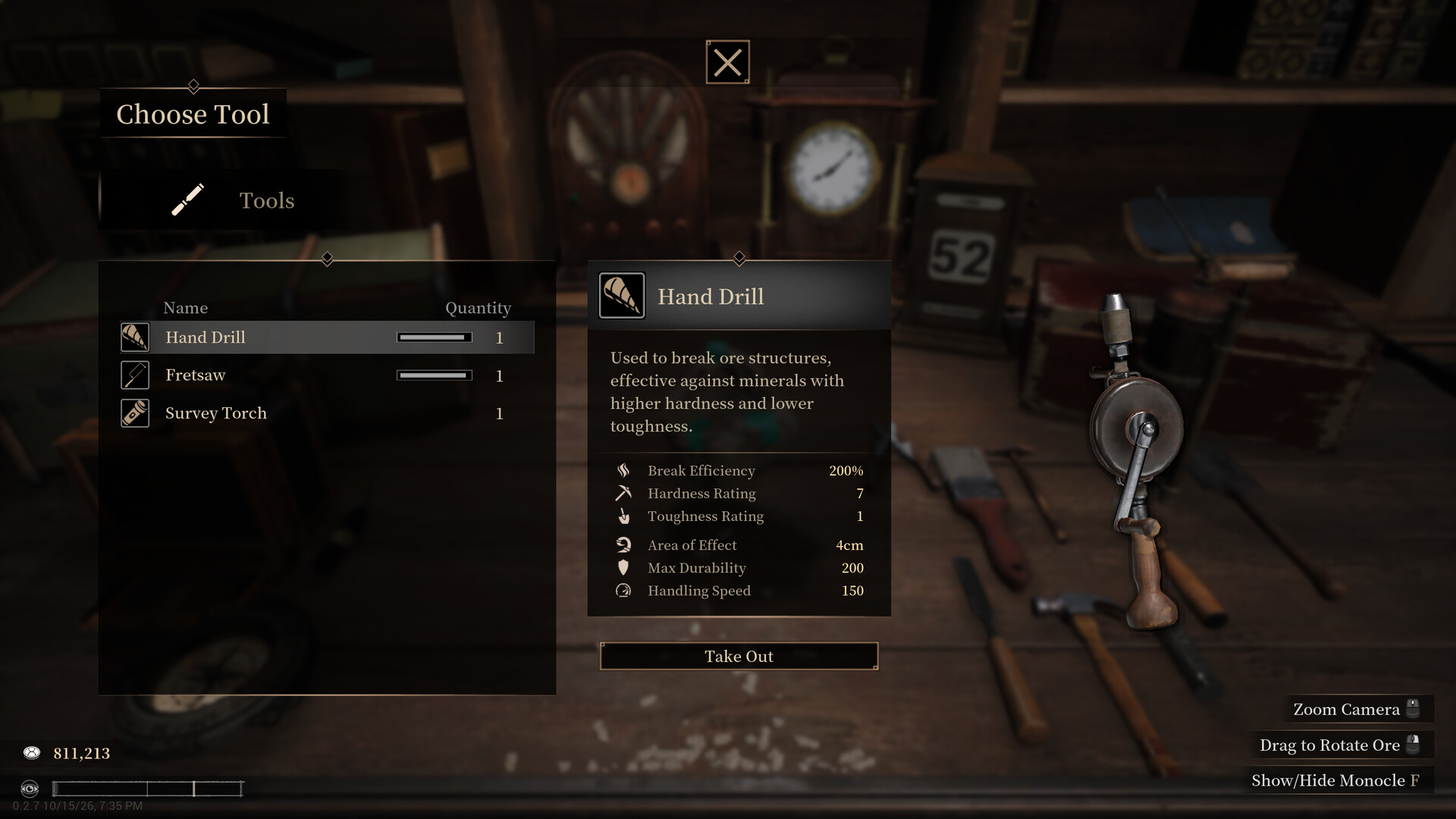
Official screenshot · Source: Steam store
You inherit Vermilion House, a struggling business in the underground city of Fathomholm. Your work combines mineral appraisal, rock breaking, precise faceting, and eventually jewelry crafting, all against a gothic mystery involving decidedly unnatural stones.
As of October 24, 2026, a public demo is available, while the full game is listed as coming soon. The guidance below distinguishes the developer’s advertised systems from the demo experience reported by PC Gamer. Exact prices, license thresholds, and complete mineral lists are not established by the available references.
The basic gemstone workflow
Think of the business as several connected tasks rather than one crafting interaction.
| Stage | What you do | Why it matters |
|---|---|---|
| Acquire material | Buy rocks and minerals from visiting sellers | Provides material to examine and process |
| Examine and appraise | Assess rough minerals | Helps you understand what you are working with |
| Break and clean | Hammer rocks and remove impurities | Reveals potentially valuable material |
| Facet and polish | Shape stones using specialized equipment | Precision affects the finished gem’s value |
| Sell or craft | Sell gemstones or set polished gems into jewelry | Connects your workshop to customer demand |
The developer confirms that different minerals behave differently. That makes careful observation more useful than assuming every stone can be processed identically.
Getting Raw Materials and Identifying Early Finds
Your early business revolves around visitors and the workstations already accessible inside Vermilion House. In PC Gamer’s demo account, customers arrived both to purchase gemstones and to sell rocks or minerals.
That is an important distinction: you do not need to assume that gathering materials means exploring a conventional mining map. The documented early experience centers on acquiring material through the shop and breaking it at your desk.
For Abyssal Lapidary gemstones, the first practical skill is understanding the difference between an unprocessed rock, the mineral recovered from it, and a finished piece ready for sale.
Confirmed mineral examples
PC Gamer reported finding the following materials while breaking rocks in the demo:
| Reported find | What the report establishes | What remains unconfirmed |
|---|---|---|
| Ordinary apatite | Apatite appears with an “ordinary” descriptor | Exact sale price and processing requirements |
| Fine apatite | Apatite also appears with a “fine” descriptor | The numerical difference from ordinary apatite |
| Crude duskstone | Duskstone appears among early recovered materials | Its full quality range and optimal cutting method |
These are examples, not a complete gemstone catalog. The report also mentions garnet and chrysoberyl conversationally, but it does not establish that the writer actually obtained either one.
Likewise, three observed descriptors do not prove a universal quality ladder. Avoid assuming every mineral exists in crude, ordinary, and fine versions until the game itself confirms it.
A sensible approach to early purchases
Because the references do not provide purchase prices or profit margins, there is no verified “best ore” to recommend. A cautious learning strategy is more useful:
- Compare the asking price with the money you can afford to risk.
- Read the information available before processing a new material.
- Record what you recover and what customers pay.
- Avoid putting your entire budget into an unfamiliar rock.
- Treat your first attempts as learning costs rather than guaranteed profit.
These are general management recommendations, not hidden mechanics. Their purpose is to help you learn the economy without depending on an unsupported price chart.
Unlocking Faceting and Protecting Gem Value
The gem faceting table is unlocked through the Silver License in the reported demo progression. PC Gamer’s writer sold goods, accumulated enough renown to apply for that license, and then gained access to the table.
That makes early selling part of your route toward more advanced lapidary work—not merely something to do after you have mastered cutting.
The documented unlock sequence
| Step | Recommended focus | Evidence or limitation |
|---|---|---|
| 1. Learn the starting workspace | Locate the rock-breaking area, customer booth, and tool-repair station | All appear in the reported demo experience |
| 2. Process early materials | Break rocks and recover saleable finds | The writer recovered apatite and duskstone |
| 3. Sell your goods | Build the business and accumulate renown | Sales preceded the reported license application |
| 4. Apply for the Silver License | Check your progression options as renown increases | The exact requirement is not supplied |
| 5. Use the faceting table | Begin practicing precise grinding | Access followed the license unlock |
Do not rely on a guessed renown requirement. The available material confirms the progression relationship, but not a number you should grind toward.
Why cutting precision matters
The clearest mechanical warning about Abyssal Lapidary gemstones concerns grinding duration. PC Gamer describes a narrow opportunity for an ideal cut, with both insufficient grinding and excessive grinding reducing value substantially.
In other words, “more grinding” is not automatically an improvement.
A useful practice routine is to:
- Read any instructions presented by the faceting station.
- Focus on one attempt at a time rather than rushing through inventory.
- Observe the feedback the game provides while grinding.
- Compare the resulting value or quality information afterward.
- Adjust your next attempt based on that result.
There is no verified universal cutting duration in the supplied sources. Since the developer says minerals behave differently, copying one fixed duration across every material would be an unreliable shortcut.
Common mistakes to avoid
| Mistake | Why it is a problem | Better approach |
|---|---|---|
| Assuming faceting is available immediately | The reported demo gates it behind a license | Work through early processing and sales first |
| Grinding too little | Under-grinding can reduce value | Learn the station’s feedback and stopping point |
| Grinding too long | Over-grinding can also reduce value | Prioritize precision over extended tool contact |
| Expecting identical mineral behavior | The developer explicitly describes differences | Observe each unfamiliar material carefully |
| Following an unsourced price ranking | No complete price table is established here | Compare actual purchases and sales in your game |
For Abyssal Lapidary gemstones, protecting value is as important as finding something promising. A good raw material does not eliminate the need for careful execution.
Selling Gemstones, Building Renown, and Crafting Jewelry
Your workshop and customer booth serve different but connected purposes. Processing gives you goods to sell; customers turn those goods into income and help support progression.
In the reported demo, visitors included gemstone buyers, mineral sellers, an artifact seeker, a loan provider, and a tea seller. However, the article does not explain every visitor’s underlying mechanics.
That means you should not assume tea provides a particular buff, loans are always harmful, or artifacts follow a known reward formula. Those details require direct confirmation.
Keep useful records instead of chasing a supposed best gem
A small transaction log can help you make informed decisions about Abyssal Lapidary gemstones without pretending the economy is already solved.
Record:
- Material name and descriptor: Keep ordinary apatite separate from fine apatite.
- Purchase cost: Note what you paid for the original material.
- Processing result: Record what you recovered or produced.
- Sale proceeds: Compare the final payment with your starting expense.
- Cutting observations: Note whether your attempt appeared underworked, overworked, or successful.
The difference between a sale price and a purchase cost is useful, but it is not necessarily complete profit if other costs apply. Track any additional expenses the game actually shows rather than assuming processing is free.
Jewelry crafting versus loose-gem sales
The official description confirms that polished gems can be set into jewelry for Fathomholm’s residents. It also connects rising reputation with increasingly unusual clients.
However, the available references do not establish jewelry recipes, setting costs, material combinations, or a guaranteed markup over loose gemstones.
Treat jewelry as a confirmed part of the game’s broader crafting design, not as a proven early-game money exploit. When it becomes available in your playthrough, compare its requirements and returns before committing your best materials.
Managing quiet periods
PC Gamer notes that the demo allows time to be fast-forwarded. This can make the slower business rhythm easier to manage when you have nothing immediate to do.
Before advancing time, a sensible checklist is to finish your current task, review available visitors, and check whether you have a progression action to take. That is a workflow suggestion, not evidence of a hidden deadline system.
Strange Minerals and What Is Still Unknown
Abyssal Lapidary gemstones are not only commercial goods. The developer’s description places unusual minerals at the center of the game’s horror: stones may display disturbing biological qualities, while continued work is associated with heightened perception and hallucinations.
Vermilion House also contains hidden spaces and records tied to its history. These elements connect the craft simulation to the mystery surrounding the inherited business.
Still, atmosphere is not the same as a documented numerical system. The available material does not establish a gemstone corruption meter, a fixed hallucination threshold, or a reliable method for neutralizing dangerous ore.
What you can safely plan around
The most dependable starting priorities are straightforward:
- Learn rock processing before advanced faceting.
- Use early sales to work toward the Silver License.
- Practice stopping your grinding accurately.
- Track real transaction results instead of assumed prices.
- Read unfamiliar mineral and customer information carefully.
The official Abyssal Lapidary Steam page is the authoritative place to check demo availability, release status, and developer announcements.
For now, the strongest approach is patient craftsmanship backed by observation. The confirmed mechanics reward learning the material and the workstation—not memorizing invented rarity rankings.
FAQ: Abyssal Lapidary Gemstones
How do you unlock the gem faceting table?
In PC Gamer’s reported demo experience, selling goods generated enough renown to apply for the Silver License. Obtaining that license unlocked access to the gem faceting table. The available references do not provide the exact renown requirement.
Which Abyssal Lapidary gemstones are confirmed?
The demo report specifically identifies ordinary apatite, fine apatite, and crude duskstone as recovered finds. These examples are not a complete mineral list, and they do not establish a universal grading system or rarity ranking.
Why do gemstones lose value during cutting?
The reported faceting mechanic penalizes both grinding for too little time and grinding for too long. There is a narrow opportunity for an ideal result, so precise stopping matters more than simply spending longer on the stone.
Can you turn gemstones into jewelry?
Yes. The developer confirms that polished gemstones can be set into jewelry for customers. However, the supplied sources do not establish complete recipes, exact unlock requirements, setting costs, or whether jewelry always earns more than selling gems individually.
Related Guides
Abyssal Lapidary activation anomaly: Demo Guide
Understand Abyssal Lapidary's anomaly warnings, unusual finds, and activation lore, with practical demo tips and clearly labeled player experience.
Abyssal Lapidary AI Usage: What Players Should Know
Explore Abyssal Lapidary AI usage claims about textures, English localization, and coding, plus what remains unverified and how to check.
Abyssal Lapidary awareness: Effects and Recovery
Learn how Abyssal Lapidary awareness rises, what hallucinations and mental overload mean, and how to manage abnormal minerals and recovery.
Abyssal Lapidary gem cutting: Beginner Guide
Explore Abyssal Lapidary gem cutting, from ore appraisal to jewelry crafting, with confirmed mechanics and practical tips for the demo.
Abyssal Lapidary Steam Next Fest: Demo Release Guide
Explore the Abyssal Lapidary Steam Next Fest demo, including its 4+ hours of content, save transfers, new features, and PC requirements.