Abyssal Lapidary showroom: Sales and Progress Guide
Explore Abyssal Lapidary showroom questions, confirmed customer mechanics, Silver License progression, and practical tips for the demo.
What Is Confirmed About the Showroom?
A beautiful gemstone will not rescue Vermilion House if you cannot turn your work into sales. If you are searching for the Abyssal Lapidary showroom, the important distinction is that current sources confirm customer trading and workshop progression—not a separately documented showroom system. This Abyssal Lapidary showroom guide explains what you can reliably act on, which unlock is documented, and where the available information stops.
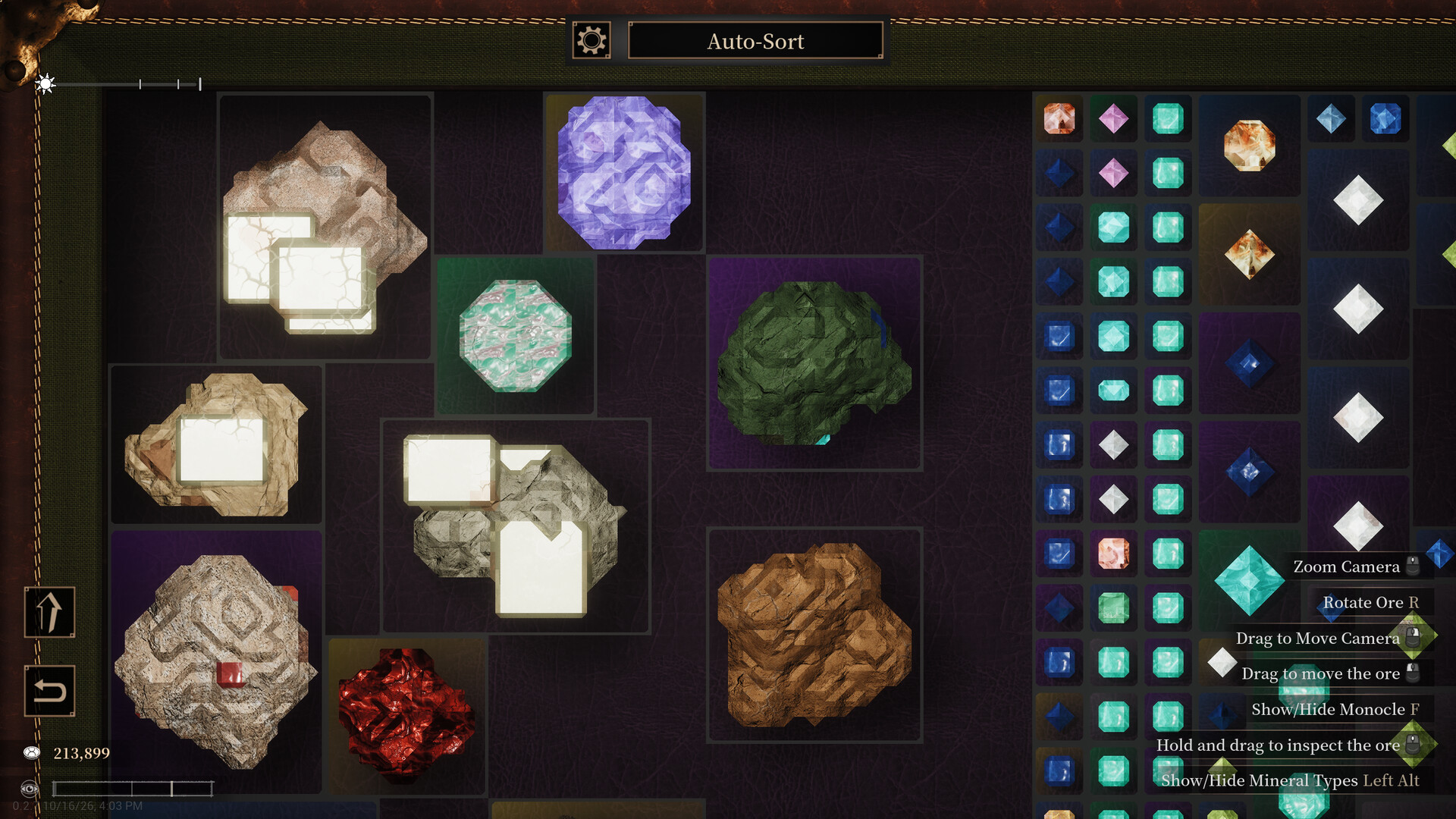
Official screenshot · Source: Steam store
As of October 24, 2026, Abyssal Lapidary has a public Steam demo, while the full game remains listed as coming soon. You inherit Vermilion House, a declining business in the underground city of Fathomholm, and work with unusual minerals while serving increasingly mysterious customers.
However, neither the supplied official description nor PC Gamer’s demo impressions identifies a dedicated room or mechanic named “showroom.” That does not prove one is absent; it means there is no verified showroom unlock walkthrough in these sources.
For the official overview, demo access, and announcements, visit the Abyssal Lapidary Steam page.
| Topic | What the available sources establish | What remains unverified |
|---|---|---|
| Customer interactions | A customer booth is accessible early in the demo | Whether a separate showroom replaces or expands it |
| Buying and selling | Visitors buy gemstones and sell rocks or minerals | Complete pricing and negotiation rules |
| Business progression | Selling goods can lead to enough renown to apply for a Silver License | Exact renown requirements |
| Workshop access | The Silver License opens access to the gem faceting table in reported demo play | A complete room-unlock sequence |
| Product displays | No display-management system is described | Shelves, decoration bonuses, and passive sales |
The practical takeaway: start with the customer booth and your available workstations rather than assuming you need to unlock a display room before trading.
How Customer Trading and Gem Production Connect
The confirmed business loop joins material acquisition, hands-on stoneworking, and customer sales. Your workshop produces the goods that support your business, while visitors provide both potential buyers and sources of new material.
PC Gamer’s reported player experience describes early access to tool repair, rock breaking, and a booth for speaking with customers. During the day, some visitors arrive to purchase gemstones; others offer rocks and minerals.
That distinction matters when investigating the Abyssal Lapidary showroom: the documented early trading interaction is customer-facing, but it is not described as a shelf-stocking or automated retail system.
From rough rock to something worth selling
The official description outlines examining minerals, removing impurities, cutting facets, and setting polished gems into jewelry. These are connected parts of the broader game, but you should not assume every stage is available immediately in the demo.
| Stage | Confirmed activity | Practical focus |
|---|---|---|
| Acquire material | Customers can offer minerals and rocks | Review purchases before committing money |
| Examine and extract | Inspect minerals and break away unwanted material | Learn what each work session produces |
| Facet gemstones | Use the faceting table after gaining access | Pay attention to the cutting window |
| Craft jewelry | Set polished gems into jewelry, according to the official overview | Treat this as a broader game feature, not a guaranteed starting option |
| Sell goods | Trade gemstones with visiting buyers | Use sales to support continued business activity |
PC Gamer’s demo session produced ordinary apatite, fine apatite, and crude duskstone. These are useful examples of the materials encountered, not a profitability ranking or a complete mineral catalog.
As a general learning strategy, note what you paid for a rock and what you eventually received from its contents. Even informal tracking helps separate a satisfying discovery from a financially successful purchase.
Not every visitor has the same purpose
The reported player experience also includes a visitor seeking mysterious artifacts, someone offering a loan, and a tea seller. Their presence suggests that customer interactions extend beyond straightforward gemstone transactions.
However, the sources do not explain the tea’s effects, loan conditions, or artifact rewards. Read the terms and dialogue you encounter rather than assuming these interactions provide free benefits.
Silver License Progression: The Documented Unlock
The clearest progression milestone in the available material is the Silver License.
In PC Gamer’s reported player experience, selling goods generated enough renown to apply for that license. Obtaining it then allowed access to the gem faceting table. This gives new players a concrete direction without relying on an invented showroom requirement.
If your Abyssal Lapidary showroom search began because a room or workbench is inaccessible, distinguish that obstacle from the documented faceting unlock. The sources establish a license connection for the faceting table—not for every locked door in Vermilion House.
A source-supported early progression route
| Step | What to do | Why it matters |
|---|---|---|
| 1 | Explore the accessible parts of Vermilion House | Find the customer booth and initial workstations |
| 2 | Speak with visitors | Identify buying opportunities and customers seeking goods |
| 3 | Process available rocks | Produce material you can trade |
| 4 | Sell your goods | Sales preceded the renown milestone in reported demo play |
| 5 | Check your eligibility to apply for the Silver License | This is the documented progression target |
| 6 | Use the faceting table once access is granted | Begin learning the more precise cutting process |
No exact renown threshold, application cost, or guaranteed completion day appears in the reference material. Avoid planning around a precise number unless the current game interface or an official update supplies it.
What locked doors do—and do not—tell you
PC Gamer’s writer encountered several locked downstairs doors and understood them as part of later progression. That supports the idea that Vermilion House opens up over time, but it does not establish the requirement behind each door.
A sensible troubleshooting order is:
- Check the objective or explanation currently shown in-game.
- Revisit the stations and customer interactions you can already use.
- Check whether a license application is available.
- Separate a clearly stated requirement from a guess about a room’s purpose.
A locked door alone does not verify an Abyssal Lapidary showroom unlock, a reputation gate, or a missing quest item.
Practical Tips for Protecting Your Early Earnings
The most useful early optimization is not an undocumented display bonus. It is reducing avoidable losses while learning how materials, sales, and faceting work.
The demo’s deliberate pace gives you room to observe results. Use that time to build a repeatable process instead of treating every new mineral as a reason to spend immediately.
Learn faceting before risking your best material
PC Gamer’s reported player experience describes a narrow window for an ideal cut. Grinding too much or too little reduced gemstone value.
This makes precision economically important. A stone with potential is not automatically a profitable finished product if the cutting process damages its value.
As a cautious learning approach, practice on less valuable material when you have a choice. That is a risk-management recommendation, not a confirmed game requirement or a guarantee that every mineral behaves identically. The official description specifically indicates that minerals differ.
Keep a simple transaction record
You do not need a spreadsheet to understand your first few trades. A short note can reveal whether you are buying material faster than your sales can support.
| Record | Example of what to note | Question it helps answer |
|---|---|---|
| Purchase | Price paid for incoming material | How much money is tied up in this rock? |
| Extraction | Mineral and quality obtained | What did the purchase actually produce? |
| Processing | Faceting result, if applicable | Did additional work preserve or reduce value? |
| Sale | Amount received from the buyer | Did the transaction recover the purchase cost? |
| Progress | Renown or license eligibility shown in-game | Is the business moving toward the next milestone? |
The table is a tracking template, not a set of hidden game formulas. Exact profit calculations may require accounting for additional costs shown in your version.
Use downtime deliberately
The reported demo experience confirms that time can be fast-forwarded. This helps when the alternative is simply waiting for activity.
Before advancing time, consider whether you still have:
- Unprocessed material you intended to examine.
- A customer interaction you want to finish.
- An available progression step to check.
- A newly accessible workstation to learn.
The advice is to use idle periods well—not to assume the game imposes a specific penalty for fast-forwarding.
For now, the strongest Abyssal Lapidary showroom strategy is really a workshop-and-trading strategy: acquire carefully, process attentively, sell goods, and pursue verified progression.
Showroom Claims to Treat With Caution
Management games often feature display cases, decoration scores, customer traffic upgrades, and automatic purchasing. Those familiar systems can make speculation sound convincing, especially when a game already contains a large house and locked rooms.
But familiar genre conventions are not evidence.
An Abyssal Lapidary showroom guide should not present the following as established mechanics based on the current references:
- Display cases that generate passive income.
- Furniture that increases gemstone sale prices.
- A particular license tier that unlocks a showroom.
- Required stock counts for opening a retail room.
- Lighting or decoration bonuses affecting customer demand.
These features are unverified, not necessarily impossible. Future announcements, fuller documentation, or direct observations may clarify them.
The same caution applies to jewelry crafting. It is part of the official game description, but the supplied demo account does not document its complete unlock route. Keep the advertised full-game scope separate from the specific early-demo progression described here.
The dated context also matters. The supplied Steam material lists a demo update dated October 23, 2026. Mechanics and requirements may change as development continues, so treat exact instructions from other versions cautiously.
For current play, prioritize information in this order: requirements explicitly shown in your build, official announcements, then clearly labeled player experience. That approach is more reliable than chasing an assumed room bonus.
FAQ
How do you unlock the Abyssal Lapidary showroom?
The available sources do not document a dedicated showroom unlock. They confirm an early customer booth and a Silver License that grants access to the gem faceting table in reported player experience. There is not enough evidence to give a reliable showroom-specific requirement.
What does the Silver License unlock?
PC Gamer’s reported demo experience identifies the gem faceting table as the unlock associated with the Silver License. The writer sold goods, accumulated enough renown to apply, and then gained access. Exact renown and payment requirements are not provided.
Can you sell gemstones before unlocking faceting?
Yes. The reported demo progression includes selling goods before obtaining the Silver License and accessing the faceting table. You therefore do not need to assume advanced cutting is a prerequisite for your first sales.
Is the full game available, or only the demo?
As of October 24, 2026, the supplied Steam listing offers a public demo and labels the full game as coming soon. The demo is useful for learning early trading and stoneworking, but its available rooms and progression should not be treated as a complete map of the finished game.
Related Guides
Abyssal Lapidary activation anomaly: Demo Guide
Understand Abyssal Lapidary's anomaly warnings, unusual finds, and activation lore, with practical demo tips and clearly labeled player experience.
Abyssal Lapidary AI Usage: What Players Should Know
Explore Abyssal Lapidary AI usage claims about textures, English localization, and coding, plus what remains unverified and how to check.
Abyssal Lapidary awareness: Effects and Recovery
Learn how Abyssal Lapidary awareness rises, what hallucinations and mental overload mean, and how to manage abnormal minerals and recovery.
Abyssal Lapidary how to sell cut gems: Sales Guide
Learn how to sell cut gems in Abyssal Lapidary through commissions and auctions, unlock faceting, and work around the demo's delivery bug.
Abyssal Lapidary Steam Next Fest: Demo Release Guide
Explore the Abyssal Lapidary Steam Next Fest demo, including its 4+ hours of content, save transfers, new features, and PC requirements.