Abyssal Lapidary lovecraftian Themes Explained
Explore Abyssal Lapidary's Lovecraftian themes, living minerals, gothic mysteries, and gem-cutting gameplay, with practical demo tips.
Why This Gem-Cutting Business Feels So Unsettling
A gemstone that seems to breathe turns an ordinary workbench into a place you might hesitate to touch. The Abyssal Lapidary lovecraftian premise matters because its horror grows from the same careful craftsmanship that makes its shopkeeping appealing. If you’re researching Abyssal Lapidary lovecraftian themes, the central idea is simple: learning to understand your materials may also expose you to things you cannot explain.
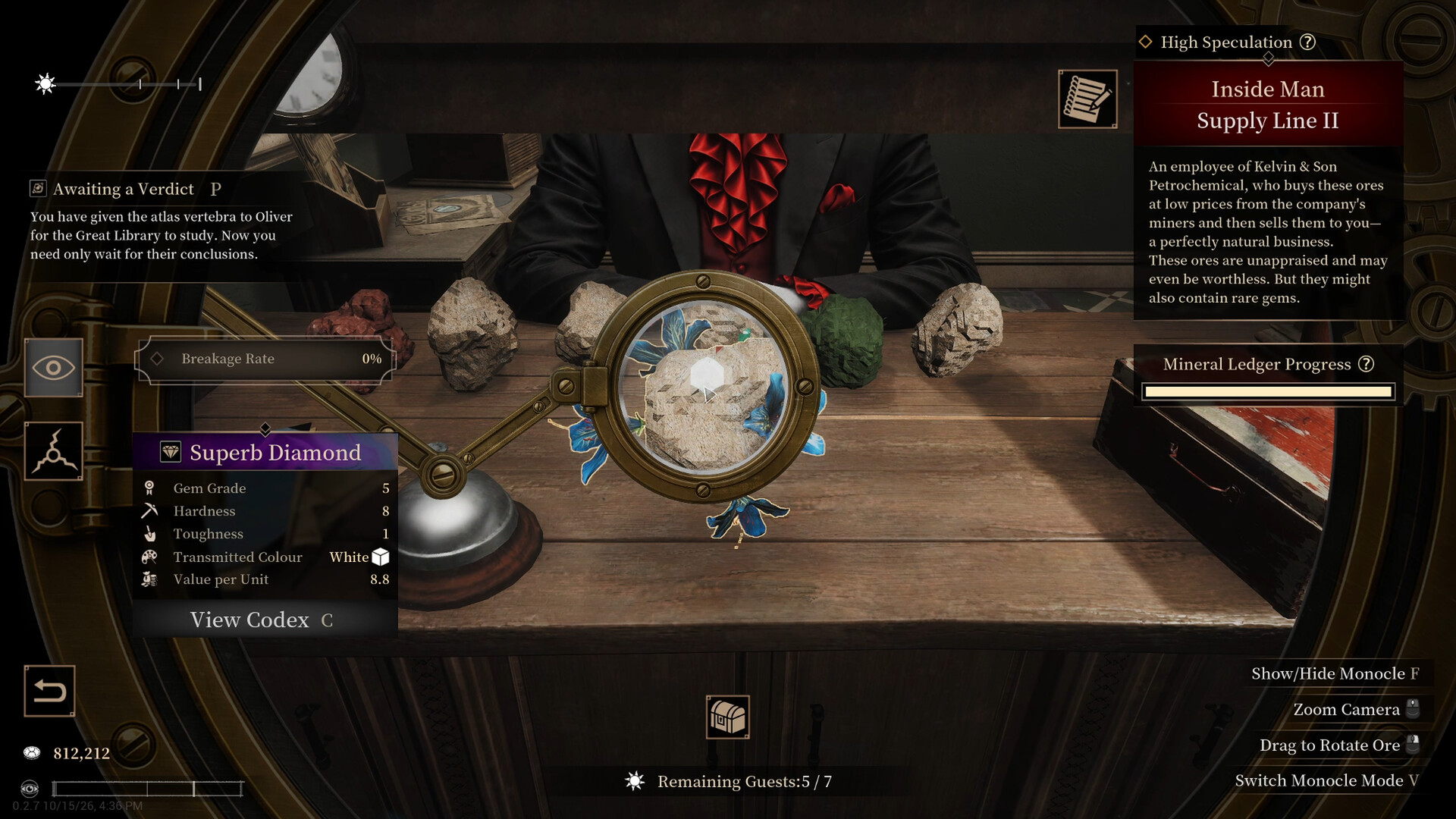
Official screenshot · Source: Steam store
Developed by Light Worm and published by XD, Abyssal Lapidary is a gothic management simulation set in a Victorian-inspired underground city. You inherit a struggling jewelry business, examine rough minerals, shape gemstones, and serve increasingly unusual customers.
That practical routine sits beside living stone, hallucinations, and a house concealing a crime. Here’s how those elements fit together—and what the available demo coverage actually establishes.
| Quick fact | Confirmed information |
|---|---|
| Setting | Fathomholm, a Victorian-inspired underground metropolis |
| Inherited business | Vermilion House |
| Core activities | Ore appraisal, mineral processing, gem cutting, and jewelry crafting |
| Developer and publisher | Light Worm and XD |
| Full release status | Listed as “Coming soon” as of October 24, 2026 |
| Demo availability | A free Steam demo is listed |
The official Abyssal Lapidary Steam page provides the game’s premise, advertised features, and current availability. Importantly, its description outlines the broader game; it should not be treated as proof that every advertised horror sequence appears in the demo.
Abyssal Lapidary Lovecraftian Themes: Knowledge Has a Cost
“Lovecraftian” describes more than tentacles or an ominous underground setting. Its most relevant ingredients here are forbidden discovery, unreliable perception, and the possibility that apparently ordinary matter follows rules beyond human understanding.
Steam includes Lovecraftian among the game’s user-defined tags. More substantially, the official description supports that interpretation through specific images: minerals with pulsing veins, flowers emerging impossibly from rock, and ores that appear to breathe.
These are not simply valuable stones with spooky names. They challenge the distinction between an object you can process and an organism that might respond.
Living Minerals Undermine Your Expertise
A lapidary’s work depends on observation. You inspect a rough specimen, identify useful material, remove impurities, and make controlled cuts.
That makes living minerals an especially effective source of unease. The closer you look, the more likely you are to discover something that does not belong in your professional understanding.
The Abyssal Lapidary lovecraftian connection is strongest in this reversal: expertise offers practical progress, but it also brings you closer to the unsettling material. Your tools help reveal what is inside the stone without necessarily making that discovery safe or comprehensible.
Sharper Perception Does Not Mean Greater Certainty
The official premise links extended work with heightened perception and increasing hallucinations. Shapes appear within minerals, and whispers disturb otherwise empty rooms.
Thematically, that creates an uncomfortable question: are you discovering something real, or becoming less able to distinguish reality from imagination?
The available material does not establish a numerical sanity meter, a hallucination-management system, or specific penalties. Those mechanics should not be assumed merely because they are common in cosmic horror.
| Advertised element | Horror interpretation | What remains unconfirmed |
|---|---|---|
| Minerals that appear alive | Familiar matter becomes alien | Whether every unusual ore has a gameplay effect |
| Heightened perception and hallucinations | Understanding may destabilize certainty | A measurable sanity or perception system |
| Increasingly strange clients | Business success brings unfamiliar encounters | Specific customer identities or consequences |
| Hidden rooms and old records | Investigation exposes buried history | The complete mystery and its resolution |
For players, the useful distinction is between confirmed imagery and inferred mechanics. The imagery clearly supports cosmic unease; the full rules governing it remain less certain.
Fathomholm and Vermilion House Add Gothic Horror
The Abyssal Lapidary lovecraftian atmosphere shares space with a more intimate gothic mystery. Rather than presenting only an unknowable abyss, the game also gives you an inherited property, a declining business, concealed rooms, and evidence of wrongdoing.
Those elements make the horror personal. You are not merely passing through a sinister location. You have inherited responsibility for it.
A City Beneath the Surface
Fathomholm’s underground setting makes mineral work feel central to the world rather than incidental. Your livelihood depends on material drawn from below, while the premise suggests that some discoveries should have remained buried.
That creates a thematic tension: the work sustaining your business is also the work bringing you into contact with the unknown.
The references do not explain the city’s complete history or social structure. Still, its combination of Victorian influence, subterranean geography, and mineral commerce provides a distinctive foundation for the story.
A House That Is More Than a Shop
Vermilion House is both your workplace and a mystery to investigate. The official description mentions concealed passages, closed-off chambers, forgotten financial records, and a room with an organic, heartbeat-like quality.
It also explicitly points toward a crime connected to the property. That gives the investigation a concrete question alongside the supernatural uncertainty: what happened here?
| Gothic feature | Its narrative role | What to notice while playing |
|---|---|---|
| Inherited, declining business | Makes the past your responsibility | How early dialogue explains your situation |
| Locked or sealed spaces | Makes the house feel only partly known | Which areas become accessible through progression |
| Forgotten ledgers | Connects investigation with business history | Records that clarify earlier events |
| Organic architectural imagery | Makes a familiar building feel physically wrong | How spaces differ from ordinary workrooms |
This combination matters because gothic and cosmic horror operate at different scales. A hidden crime may be understandable through evidence. Whatever exists within the minerals may resist that kind of explanation.
The strongest potential lies in the overlap: a human history that leads toward something less human.
How Gem Cutting Supports the Horror—and How to Approach It
The Abyssal Lapidary lovecraftian appeal depends on the workshop being engaging before it becomes disturbing. If the everyday craft feels tangible, even a small deviation—a strange shape, an unexpected sound, an apparently breathing specimen—can carry weight.
PC Gamer’s October 23, 2026 demo impressions describe a methodical experience built around breaking rocks, discovering useful minerals, selling goods, and unlocking more advanced equipment. That is published hands-on coverage, not a comprehensive account of the finished game.
What the Demo Coverage Establishes
The writer encountered work areas for tool repair and rock breaking, along with a customer booth. Visitors bought gemstones or offered raw materials, while other encounters included an artifact seeker, a lender, and a tea seller.
After earning enough renown, the writer obtained a Silver License, which unlocked access to the gem-faceting table.
Faceting required precision. According to that account, grinding for too much or too little time reduced a gem’s value. The writer also reported a time-advance feature that helped with quiet periods.
These details suggest that the ordinary business already demands attention, even before considering the advertised supernatural layer.
| Demo activity | Practical challenge | Useful approach |
|---|---|---|
| Acquiring raw material | Recognizing what you are buying | Read descriptions before committing money |
| Breaking rocks | Finding useful material inside | Use early specimens to learn the workflow |
| Selling gemstones | Building funds and renown | Track both forms of progress |
| Unlocking faceting | Meeting progression requirements | Watch for license requirements |
| Grinding facets | Avoiding value-reducing mistakes | Prioritize control over speed |
| Waiting between tasks | Managing downtime | Use time advancement when appropriate |
Five Practical Tips for a First Session
- Learn one workstation at a time. Understand the basic handling of rough material before expecting consistent results from advanced cutting.
- Check progression requirements. The reported Silver License unlock is a reminder that new equipment may depend on business achievements.
- Treat precision as part of your finances. Cutting mistakes can lower value, so a slower attempt may be more useful than a rushed one.
- Revisit previously inaccessible areas. Demo coverage describes locked doors associated with later progression, although not every door’s requirement is documented.
- Separate observation from explanation. An unusual visitor or item is worth noting, but its purpose may not be immediately clear.
One example deserves particular caution: PC Gamer’s writer bought tea but did not establish its function. That does not support claims that tea restores sanity, prevents hallucinations, or provides any other specific effect.
For the same reason, do not assume the lender is mechanically dangerous or that every artifact is cursed. Those are plausible genre expectations, not confirmed facts.
Is This a Relaxing Sim or a Horror Game?
The available evidence points toward a deliberate mixture. Published demo impressions emphasize patient, satisfying craftsmanship, while the official description promises hallucinations, living minerals, and disturbing discoveries.
For anyone assessing the Abyssal Lapidary lovecraftian experience, the key distinction is pace versus subject matter. A game can move slowly and still become deeply unsettling.
| If you enjoy… | What may appeal to you | What to keep in mind |
|---|---|---|
| Hands-on crafting | Turning rough material into polished gems | Precision mistakes can affect value |
| Shopkeeping progression | Selling goods and unlocking equipment | Some activities begin behind progression gates |
| Gothic mysteries | Investigating an inherited property | The complete story is not documented in the references |
| Cosmic horror | Living matter and uncertain perception | Horror intensity across the full game is unverified |
| Unhurried simulation | Methodical work and time advancement | Slow pacing does not guarantee gentle content |
Set Expectations Before Downloading
Approach the demo as a chance to test three things: whether you enjoy mineral processing, whether the faceting demands feel satisfying, and whether the atmosphere makes you curious enough to investigate further.
The Steam listing includes accessibility features such as saving at any time, color alternatives, camera comfort options, and custom volume controls. It also lists play without quick-time events. However, the precise implementation should be checked in-game; those features do not establish a scare-free experience.
The most interesting promise here is not simply “a jewelry simulator with monsters.” It is a workshop where professional curiosity and supernatural discovery become difficult to separate. You keep examining the stone because that is your job—and because you want to know what is inside.
FAQ: Abyssal Lapidary Lovecraftian Themes
Is Abyssal Lapidary based directly on H. P. Lovecraft?
The supplied references do not identify it as an adaptation of a specific Lovecraft story. Its Lovecraftian qualities come from forbidden discoveries, disturbing minerals, hallucinations, and abyssal imagery. The Steam listing also carries a user-defined Lovecraftian tag.
Does Abyssal Lapidary have a sanity meter?
A numerical sanity meter is not confirmed by the available material. The official description connects ongoing work with sharper perception and hallucinations, but it does not explain those effects as a measurable resource or provide rules for managing them.
Can you play Abyssal Lapidary now?
As of October 24, 2026, Steam lists a free demo, while the full game remains marked “Coming soon.” The supplied references do not provide a confirmed full release date.
Is Abyssal Lapidary mainly crafting or horror?
It combines a crafting and business-management foundation with gothic mystery and cosmic-horror themes. Published demo coverage focuses on mineral processing, sales, and precise gem cutting. The official description presents the wider supernatural premise, but the full balance between workshop routine and horror remains to be seen.
Related Guides
Abyssal Lapidary cthulhu: Cosmic Horror Explained
Explore Abyssal Lapidary's Cthulhu connection, living gemstones, gothic mysteries, and crafting gameplay, plus what the Steam demo confirms.
Abyssal Lapidary gem cutting: Beginner Guide
Explore Abyssal Lapidary gem cutting, from ore appraisal to jewelry crafting, with confirmed mechanics and practical tips for the demo.
Abyssal Lapidary activation anomaly: Demo Guide
Understand Abyssal Lapidary's anomaly warnings, unusual finds, and activation lore, with practical demo tips and clearly labeled player experience.
Abyssal Lapidary demo: Release, Gameplay, and PC Specs
Try the free Abyssal Lapidary demo on Steam. Explore its release details, gem-cutting gameplay, beginner tips, PC requirements, and horror setting.
Abyssal Lapidary PC: Demo, Specs, and Release Info
Explore Abyssal Lapidary PC platforms, Steam demo access, system requirements, release status, and beginner tips for its gothic gemstone business.